SPACEFLIGHT Aeronautics on Mars
Flying over Mars
Earlier this year, NASA conducted a series of autonomous helicopter flights over the surface of Mars as part of the Perseverance Mars rover mission. However, so successful were the flights that NASA has extended the mission to include a new operations support phase. BILL READ FRAeS reports on the flights of the Ingenuity Mars helicopter.
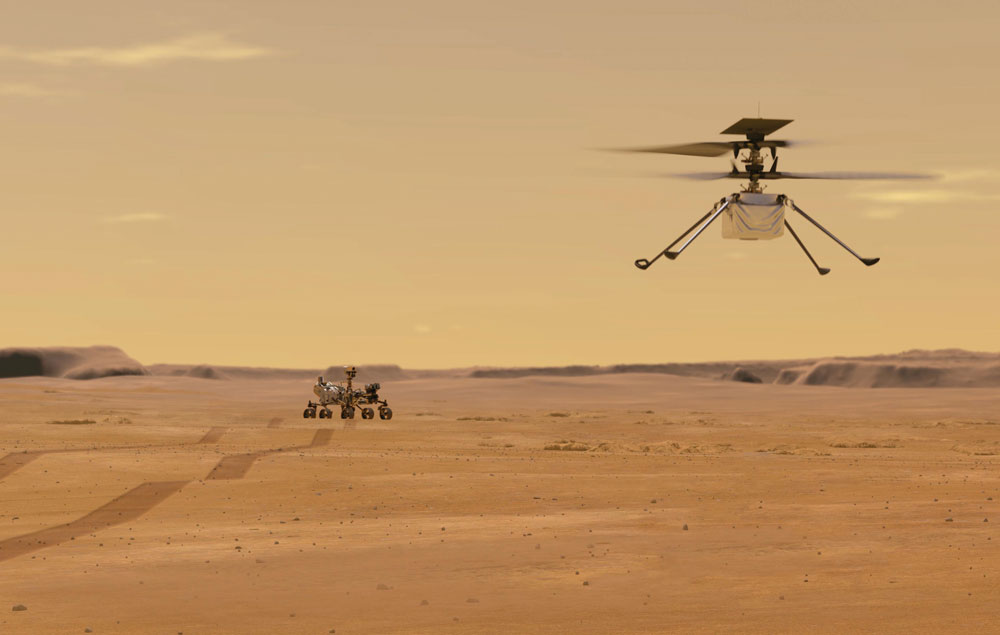 CGI rendering of Ingenuity in flight. NASA
On 30 July 2020, NASA launched the Perseverance rover from Cape Canaveral aboard a United Launch Alliance Atlas V rocket. Once in orbit, the spacecraft then set off on a 293m mile (471m km) journey to Mars which was completed on 18 February when the rover landed in the Jezero crater on Mars.
The primary mission of Perseverance is to characterise the planet’s geology and past climate, including the search for signs of ancient microbial life. The rover will collect Martian rock and regolith for future return to Earth by NASA’s next Mars lander scheduled for launch in 2026. However, during April, this mission was paused while a new space technological first was achieved – to fly the first powered, controlled aircraft on Mars.
Included in the payload of the Mars 2020 spacecraft to Mars was the Ingenuity Mars Helicopter which was stored sideways under the belly of the Perseverance rover. During the journey, the power system on the spacecraft periodically charged Ingenuity’s batteries to 35% – the level of charge the Ingenuity team had determined as optimal for battery health during cruise.
Starting from 3 April, the helicopter was deployed in a series of stages over a period of around 10 sols (Martian days – 31 Earth days is equivalent to 30 sols). The first stage involved Perseverance dropping the protective debris shield deployment box exposing the Mars helicopter to the Martian environment for the first time. The rover then carried the helicopter to the location of the helipad take-off site. The lock was released on the Mars Helicopter Delivery System and the helicopter was slowly rotated to face the surface. The helicopter legs were then extended and the vehicle dropped six inches (15cm) down to the surface.
Perseverance then drove away to expose Ingenuity to the Sun so the helicopter could recharge its batteries. The rover then moved to a parking spot about 330ft (100m) from the edge of the flight zone. NASA has named the helicopter’s take-off and landing zone as Wright Brothers Field, while the zone occupied by the rover (named Twitcher’s Point after the popular name for bird watchers) was selected where the ground was relatively level and allowed direct line-of-sight between the rover and the helicopter during all portions of potential flight tests for optimal radio communications and imaging.
On 7 April Ingenuity unlocked its rotor blades, allowing them to spin freely. There was then a delay of eight days after a command sequence error cut short a spin-up test of the helicopter’s rotors. On 16 April (which NASA remarked was also the 154th anniversary of Wilbur Wright’s birth), the helicopter completed a rapid spin test.
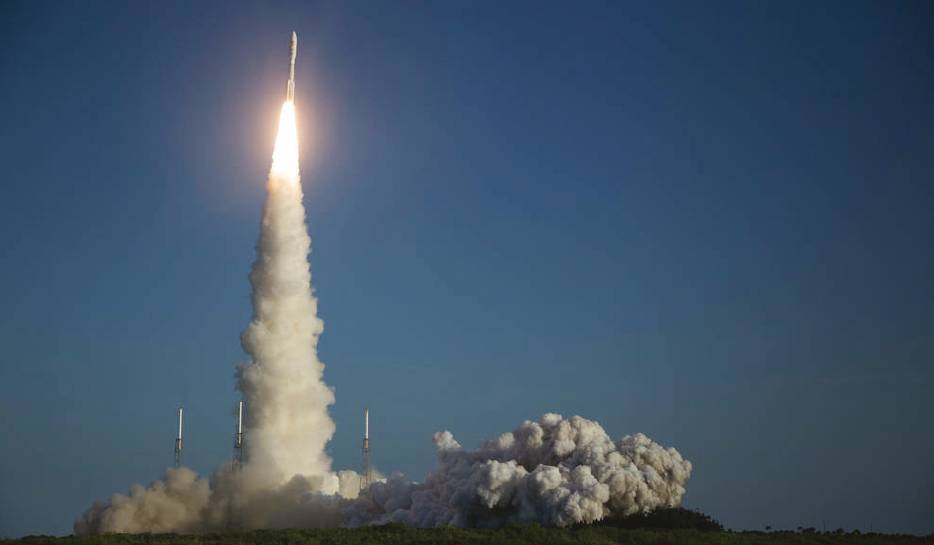 Launch of the Mars 2020 mission. NASA
On 19 April, the helicopter made its first controlled atmospheric flight of a powered aircraft on another planet. The goals of Flight Test No 1 were simple – to lift off, climb, hover, and land – which Ingenuity achieved, taking off to an altitude of 10ft (3m), hovering, turning and then setting down in the same location.
This was followed by a second flight on 22 April in which Ingenuity climbed to an altitude of 16ft (5m), moved laterally nearly 7ft (2m) and then returned to its original position for landing. On 25 April, Ingenuity made its third flight, ascending again to 5m and then flying horizontally for a distance of 50m before returning to its take-off spot, a total flight time of 80 seconds. The flights were recorded from the Perseverance rover’s Mastcam-Z while cameras on board Ingenuity also took pictures.
The original plan was that Ingenuity would conduct two more technology demonstration flights and then Perseverance would return to its main mission of exploring the Martian surface. However, on 30 April, NASA held a press conference which announced that the helicopter would now have an additional new operational mission – of assisting the rover with its exploration.
NASA has been involved with plans for flying aircraft over other planets since the 1970s, when NASA engineer Dale Reed designed a series of ‘Mini-Sniffer’ drones to take air samples at high altitudes, three of which were built by NASA Dryden Flight Research Center and flown from 1975 through 1982. The design was considered by NASA for planetary atmospheric sampling flights over Mars but nothing came of the project. In the 1990s, NASA began studying Mars rotorcraft and other vertical lift planetary aerial vehicles. The development of the Ingenuity Mars helicopter took six years and cost NASA $85m.
Ingenuity consists of a small body containing navigation and communications instruments, batteries, motors and a heating system to protect the equipment from the cold. Below the body are landing legs while above are two 1.2m diameter counter-rotating rotors.
There is also a link with the past. On the underside of the Ingenuity’s solar panel is a small swatch of muslin taken from the wing of the original Wright Brothers Flyer 1, now preserved at Carillon Historical Park in Dayton, Ohio. The International Civil Aviation Organization has also given Ingenuity’s first flight the official ICAO designator IGY, operating as call-sign INGENUITY.
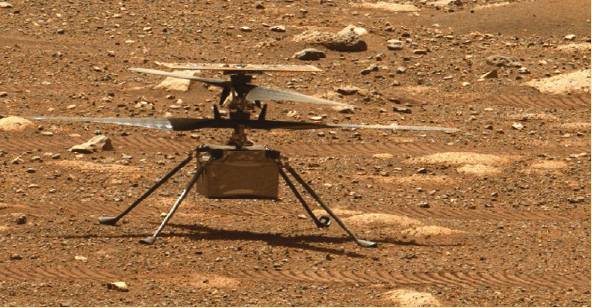 NASAWeight: Around 4.0lb (1.8kg) on Earth (equivalent to 1.5lb (0.68kg on Mars)
Height: 1.6ft (0.49m)
Rotor system: Four counter-rotating carbon fibre rotors
Fuselage (body): 5.4 × 7.7 × 6.4in (13.6 × 19.5 × 16.3cm); four 1.26ft (0.384m) carbon composite landing legs)
Power: Solar panel on top of the rotor system charges six lithium-ion batteries, providing enough energy for one 90sec flight per Martian day (~350 Watts of average power during flight)
Payload: One black-and-white 0.5 megapixel downward-facing navigation camera and one colour 13 megapixel horizon-facing terrain camera
NASA engineers faced a wide range of challenges in the design of the helicopter, one of the biggest of which was size and weight. The rotorcraft’s onboard computer, batteries, sensors, and heaters all had to fit in a very small space while the whole aircraft, including rotor blades and motors, had to conform to a strict weight limit. Not only this but the components also had to survive the stresses of spaceflight, including vibration, radiation, shielding from micrometeorites and extreme hot and cold temperatures encountered in deep space and during the descent onto the surface of Mars.Other problems to be overcome were those of power and temperature. Ingenuity is capable of autonomously charging itself using a solar panel and is also fitted with a programmable thermostat designed to keep it warm in the extreme cold temperatures of Mars which can be as low as –130º F (–90ºC).
... ANOTHER ISSUE IS THAT OF CONTROL. THE DISTANCE BETWEEN MARS AND EARTH MEANS THAT RADIO SIGNALS TAKE 16 MINUTES TO TRAVERSE THE INTERVENING SPACE
Although the helicopter weighs less than on Earth, the atmosphere of Mars is equivalent to less than 1% of the density of Earth at sea level and the rotors have to spin at speeds of close to 2,500rpm to create enough lift to enable Ingenuity to ascend. The rotor blades also had to fold while in transit, then unlock, can change angle or pitch and perform low-speed (50rpm) and high-speed (2,400rpm) spin tests while remaining on the surface.
Another issue is that of control. The distance between Mars and Earth means that radio signals take 16 minutes to traverse the intervening space, making it impossible for engineers to have realtime control of the helicopter. Because of this, Ingenuity is designed to fly, land, communicate, manage its energy and keep warm autonomously. Mathematical algorithms enable the helicopter to fly in the thin atmosphere, keep track of its movements and ensure it remains on the planned flight path.
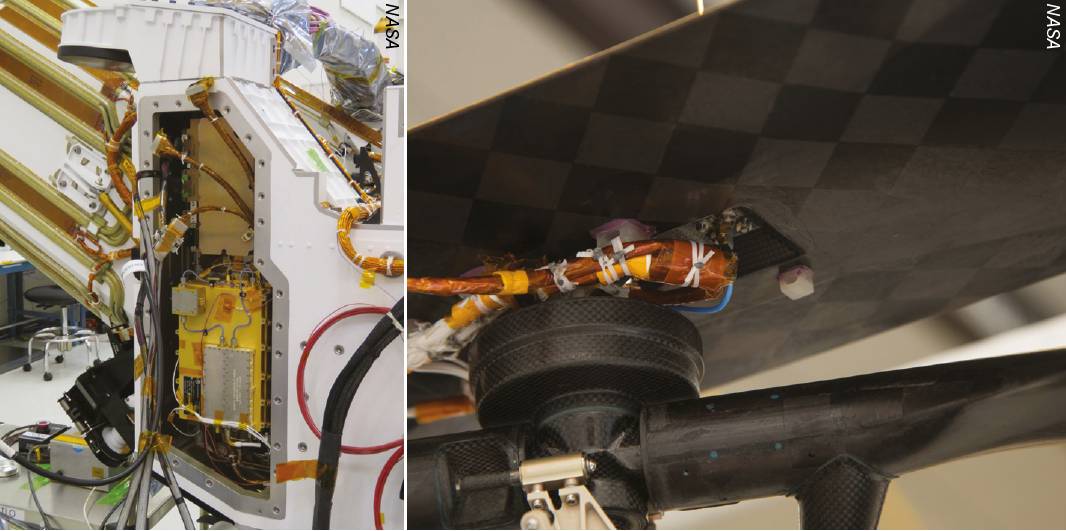 Above left: The Mars Helicopter Base Station – the gold-coloured box near the back of the Perseverance rover stores and routes communications between NASA’s Ingenuity Mars helicopter and mission controllers on Earth. Above right: The Ingenuity carries a small swatch of muslin material taken from the wing of the Wright Brothers Flyer 1. NASA
In the original schedule, Ingenuity was to conduct up to five flight tests. The schedule for each test is divided into three-sol blocks. In addition to flying the helicopter, engineers use the first sol of each block to finalise and transmit command sequences and acquire preliminary data and images from the flight test. From this, the Ingenuity team will analyse the vehicle’s performance and plan the next sortie. More engineering data and images will come in on the second day providing the helicopter team with more information about the flight. The team will then decide to begin a new test block and what kind of flight profile to attempt.
The scope of the flight tests have limitations, as Ingenuity needs to stay within communications range of the Perseverance rover. Its altitude is also constrained by an altimeter which uses a laser range finder to measure the distance from the helicopter to the ground which NASA thinks is probably around 10m.
Each flight follows a set of rules
- The helicopter will begin and end each flight from a 33ft x 33ft (10m x 10m) airfield.
- The helicopter will fly at an altitude of 10-15ft (3-5m) and travel as far as 160ft (50m) before returning to the starting area.
- Each flight will last no more than 90 seconds.
At its 30 April press conference, NASA announced that Ingenuity’s mission will not now end with just five test flights. On 30 April the fourth flight flew 133m south to examine a potential new landing ground and a fifth flight on 7 May transferred the helicopter to that site. From the middle of May up to the end of August the helicopter will begin a series of flights from a new landing ground in support of the Mars rover. Both the helicopter and the rover will then prepare for solar conjunction in October when Mars and Earth are on opposite sides of the Sun and communications are blocked.
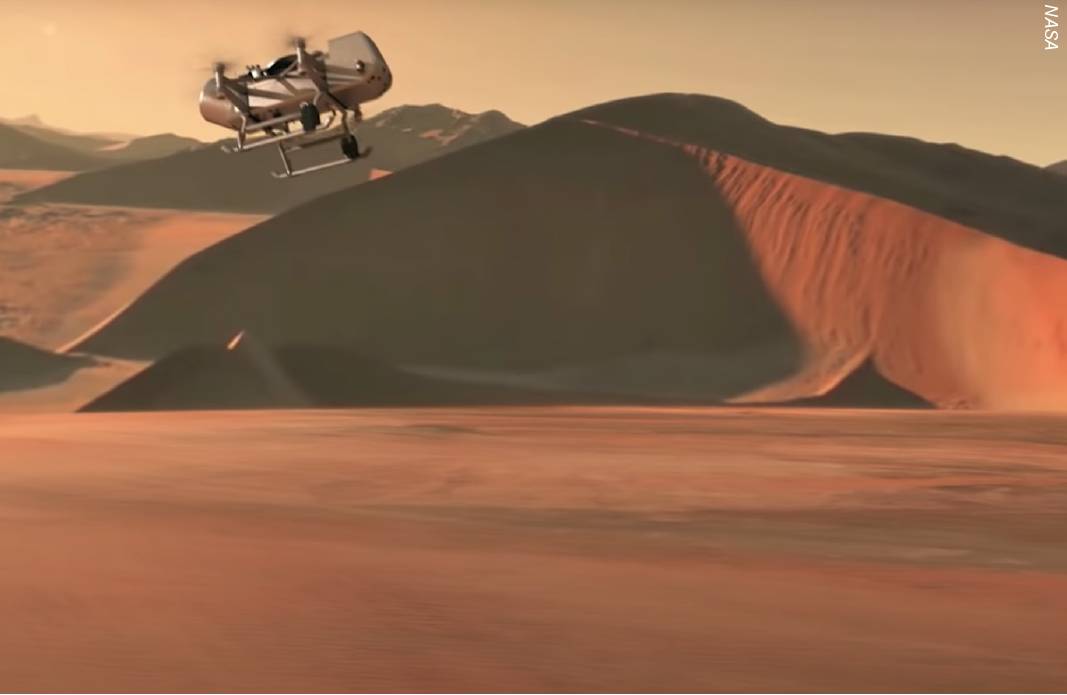 Concept art of Dragonfly flying on Titan. Geoffrey A. Landis
NASA is keen to stress that Ingenuity is an experimental technology demonstrator and does not carry any scientific instruments. The helicopter has an engineering objective rather than a scientific one which is to demonstrate the feasibility of rotorcraft flight in the extremely thin atmosphere of Mars. However, the camera carried on the helicopter can be used to scout ahead for potential routes and exploration areas for the rover to go to.