Obituary
CEng FIMechE AFAIAA FRAeS
1934-2020
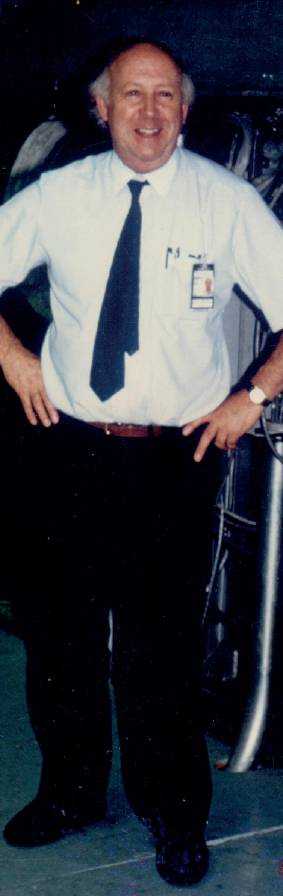 Michael John Goodyer, age 86, of Chandlers Ford, Hampshire, Professor of Experimental Aerodynamics and Freeman of the City of Coventry, passed away in the family home on 6 September 2020.
Born to George Robert and Eva May Goodyer on 9 June 1934 in Coventry. After attending King Henry VIII grammar school 1945-50, he was accepted as an apprentice to Armstrong Siddeley Motors Ltd studying Automobile and Aeronautical Engineering. He gained his HNC in Mechanical Engineering in 1954 and was awarded a scholarship to the College of Aeronautics, Cranfield, in 1956. With a specialisation in aircraft propulsion he gained his MSc in 1958 and returned to now Bristol Siddeley Engines Ltd in Coventry as Section Leader of the performance section.
In 1963 his long association with Southampton University began with his appointment as a Research Fellow to the Department of Aeronautics and Astronautics. Promoted to Lecturer in 1966, he gained his PhD in Experimental Aerodynamics in 1968 and remained in this post until his promotion to Senior Lecturer in 1978, Reader in Experimental Aerodynamics in 1985, Deputy Head of Department in 1993 and ultimately held the Acting-Head of Department position at his retirement in 1995.
In the late 1960s discussions were taking place around the accuracy of data gleaned from windtunnel testing of aircraft. Interference from the model support and tunnel sidewalls along with the issues of aerodynamic scale were causing significant differences between test and flight data. NASA Langley Research Center in Virginia, US, was working on a proposal for magnetic suspension of the model to eliminate the interference from the support structure but the costs and technical challenges associated with scaling up this proposal were proving prohibitive. In 1969 Robert A Kilgore from NASA Langley visited Southampton University to complete his PhD. The two men talked at length about possible solutions. Prof Goodyer was aware of a proposal from a textbook published in 1952 (Wind-tunnel Techniques) where the gas in the tunnel would be cooled cryogenically to help rectify aerodynamic scale issues. He suggested a small wind tunnel with a magnetic suspension system and cryogenically cooled working fluid. NASA became very excited by the proposal and a consultancy offer was made, a collaboration that lasted from 1970-1991.
Professor Goodyer’s inspirational work with the practical application of cryogenic cooling for high Reynolds number aerodynamic testing won him a NASA Special Achievement Award in July 1973 and a second in October 1973 ‘For the conceptual studies, engineering, design, fabrication, assembly and initial operation of the Langley pilot cryogenic high Reynolds number transonic pressure tunnel’. In addition, during January 1974, he was awarded a NASA Certificate of Recognition for his inventive work on a stagnation pressure probe and received a Group Achievement Award in November 1975 again, ‘for outstanding scientific achievements related to the cryogenic wind tunnel concept’. A paper co-authored by him won the Outstanding Publication within the Aeronautics Directorate at Langley in October 1983. Ultimately, in 1984, he was awarded the NASA Medal for Exceptional Scientific Achievement and the NASA Space Act Award in 1990 for his scientific contribution to the development of the National Transonic Facility (NTF), the world’s largest pressurised cryogenic wind tunnel, located at NASA Langley.
Despite numerous trials and studies the magnetic suspension of models has yet to see many practical applications. However, several cryogenic wind tunnels have been constructed both in the US, Europe and the wider world. Data from NTF and the European Transonic Wind-tunnel (ETW) have been used in many legacy programmes and are still in use advancing the design of military and commercial air vehicles.
Throughout the 1980s and 1990s Prof Goodyer was in high demand for his expertise. Numerous lecture tours took him all over the world visiting, among others, Japan, Taiwan and Australia. He was one of the first western scientists to be invited to post-Mao China, in 1983 visiting the Beijing Institute of Aerodynamics, Northwestern Polytechnical University (NPU) in Xi’an and the Chinese Aerodynamic Research and Development Center (CARDC) in Mianyang. In 1986 he visited the Nanjing Aeronautical Institute and he made two further visits to NPU in 1991 and 1994. He was appointed Honorary Professor at NPU in 1994 and selected by Shaanxi Education Commission as Model Foreign Teacher (Expert) of Higher Education in Shaanxi Province in 1993-4. He also acted as consultant to many companies and institutions, including British Aerospace, Vickers, the Royal Aircraft Establishment and, of course, the ETW group.
In 1990 he was elected Associate Fellow, American Institute of Aeronautics and Astronautics and in 1994 as a Fellow of the Institute of Mechanical Engineers and of the Royal Aeronautical Society.
In retirement he used the wind tunnel located in his garage loft at home to design, calibrate and sell yawmeters through his company, Consultant Engineering Associates.
He married Pauline Brookfield on 8 September 1956 spending many happy years with her until her death from leukemia in December 2011. He is survived by his daughter Anne and son John. He has four grandchildren and four great-grandchildren. He had a strong sense of family and an intelligent, quick and cheeky sense of humour.
John Goodyer