Book Reviews

AIRLINER MODELS

Marketing Air Travel and Tracing Airliner Evolution Through Vintage Miniatures

By A J Lawler

The Crowood Press, Ramsbury, Marlborough, Wiltshire SN8 2HR, UK. 2019. 336pp. Illustrated. £50. ISBN 978-1-78500-633-3.
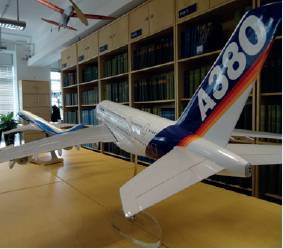
The invention of machines has always been accompanied by the creation of smaller-scale models of these machines to help convince people to use them, to buy them, to finance their development and to inspire people to improve them. The headquarters of the great shipping lines contained wonderful models in glass cases of the vessels representing the state of the art of technological development. Over the past 100 years air transport has developed, allowing ordinary people to live their dreams of travel to distant lands and these dreams have been inspired from the outset by beautiful, intricate airliner models visible through travel agents’ windows. Such models have also been used to persuade the world’s airlines to order aircraft and company boards, bankers and governments to authorise their production.

Anthony Lawler has been inspired by such models since his boyhood and nourished this passion, and his extensive collection, throughout his long and distinguished career in airliner marketing. He is one of a small, discreet group of expert collectors in the world. Although no self-respecting air museum would be complete without a large number of models, they tend to follow the theme of the museum. Hence an original idea to chronicle the development of airliners worldwide in this photographic journey through the models that ensured their promotion.

The models featured in the book were professionally made, primarily from wood or metal, until plastic became a material of choice. The majority are from the author’s personal collection, supplemented by those of fellow collectors, former and current model-makers, and those from the historic model collections of the Science Museum, London and the Museum of Transport and Technology, Auckland.

Anthony Lawler has been inspired by such models since his boyhood and nourished this passion, and his extensive collection, throughout his long and distinguished career in airliner marketing

Containing over 800 colour photographs, the book is structured chronologically with a chapter for each decade from the 1920s through to the 1980s, followed by a single chapter covering 1980 to the present day. This structure gives greater place to the wider variety of airliner designs in earlier years as the industry was maturing, without ignoring modern airliners, even if the models are distinguished more by their liveries than fundamental visual differences in their designs.

The discerning reader may find the subsequent chapters even more interesting as they contain profiles of the model makers themselves, listed alphabetically by country. A few of these are large, successful companies with long histories, many smaller ones have fallen by the wayside or been absorbed, and some existed only through the talents of individual craftsmen. A dedicated chapter covers model bases in the broadest sense, illustrating the many different ways in which models were presented. In contrast to today, these were often in the form of ornate ashtrays, for example a sterling silver Trident 1 model originally presented to the Chairman of British European Airways.

Interspersed between the main chapters are a series of ‘Treasure Hunts’, each of which tells the tale of how a particular model was acquired by the author for his personal collection. These stories are uplifting and will strike a chord today with the many passionate aviation people who try to inspire the younger generation.

The book concludes with an account of how models are used in the marketing of airliners towards airlines, rather than the promotion of air travel. Such models might serve to illustrate a particular feature of a design, such as a swing-opening tail, but equally the models might be of new designs that are never actually built in the same configuration as the one promoted.

Aircraft manufacturers have used models to promote sales since the outset. One particularly remarkable model featured in the book is a 53-inch span Handley Page 0/400 airliner made from wood, metal and fabric by the Handley Page workshops. Many others, particularly from the pre- and immediate post-WW2 era, contain incredible component and interior cutaway detailing.

The models themselves are the true stars of this book, although their stories are interwoven with those of their builders and that of a caring collector sharing his passion with the reader. A choice was made only to identify the ownership of a model where specifically requested. That left me feeling curious and a little hungry as I would have preferred identification, except where the owner did not give permission. Notwithstanding, this is a book to read, to leaf through with pleasure, to leave out in full sight of friends and visitors and to come back to.

In future, airliner models are likely to be commissioned for the niche uses of marketing and specialised trade shows but the heyday of models like those featured here, often works of art requiring so many hours of labour from true craftsmen, are long past, and Airliner Models is a fitting tribute to them.

Bob Lange
FRAeS 
IN TURBULENT SKIES

British Aviation Successes and Setbacks 1945-1975

By P Reese

The History Press, The Mill, Brimscombe Port, Stroud, Gloucestershire GL5 2QG, UK. 2020. 295pp. Illustrated. £19.99. ISBN 978-0-7509-9302-9.

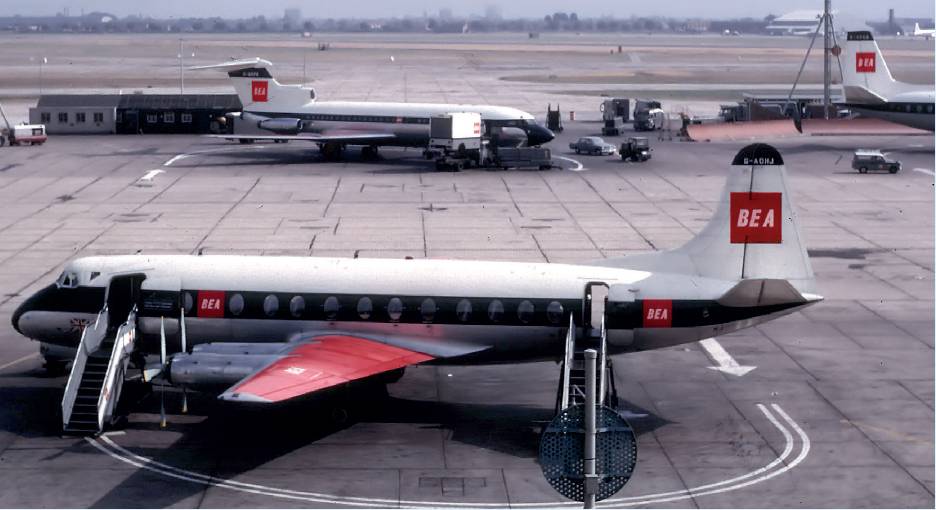
Vickers Viscount 802, G-AOHJ, of BEA at London Heathrow Airport in 1964. Behind is a Hawker Siddeley Trident. The Viscount was a response to the Brabazon Committee’s Type IIB design for a short-haul, propeller turbine powered pressurised airliner. Around 445 Viscounts were built between 1948 and 1963. Adrian Pingstone.​The decline of the British aircraft industry between 1945 and 1975 is a well-known story and Peter Reese tells it well.

In 1945 Britain was as advanced as the US in the design of fighter aircraft,and possibly bombers, although it had fallen behind in design and construction of commercial transport aircraft. Governments of both colours saw the aircraft industry as a major element of foreign trade and, from at least 1942, were planning to revive the production of commercial transports for a world market, aided by Britain’s undoubted head start in gas turbine propulsion.

Sadly, this was not to be. The specification by the Brabazon Committee for a non-stop transatlantic airliner led to an unsuitable aircraft, though the Committee is often not given credit for correctly specifying the Comet, Viscount and Dove, and the Airspeed Ambassador was a good aircraft, even if it did not sell overseas. But the first aircraft to appear, the Avro Tudor, suffered technical problems before two disappeared over the Atlantic. A few years later the promising progress of the Comet was cut short by the fatigue failure of the fuselage that cost two aircraft and their occupants. Development of the Britannia was delayed by engine icing problems so that it was overtaken by the pure jet B707 and DC-8. Cancellation of the V-1000 military jet transport meant that a civil version was not available for the first generation of transatlantic orders.

In military aviation, the British position was weakened by delay in developing a swept wing fighter to match the Sabre and then failure to produce a low supersonic fighter, such as the F-100. Cancellation of the Miles M-52 supersonic research aircraft also set back progress. The 1957 Sandys White Paper prioritising missiles over manned aircraft blocked a generation of military aircraft except for TSR-2, which in turn was cancelled in 1964.

The decline of the British aircraft industry between 1945 and 1975 is a well-known story, and Peter Reese tells it well

Reverting to civil transports, the stories of the Trident and VC-10 have been told by Keith Hayward. Both failed to achieve substantial overseas sales because they were based on specifications too specific to BEA and BOAC. The BAC 111 achieved reasonable sales but only a fraction of the DC-9, partly because of accidents during development and partly because of the delay in producing stretched developments, when compared to Douglas.

The final section suggests that part of the decline was a result of poor project specification and management by governments but that there was no wish to run down the aviation industry. Another important factor was the technical ability of the industry to deliver the aircraft specified. Failures of the Tudor and Comet, the deep stall accident of the BAC 111 and engine icing on the Britannia, blighted their prospects. In military aviation, projects such as the Swift were technically unsuccessful.

The author also suggests that “within the UK a sense of misplaced self-confidence and the wish to ‘return to normal after the war’ served to encourage its aircraft manufacturers to continue with their time-honoured methods of production and for aviation to remain a fragmented industry with its 27 aircraft firms and eight engine manufacturers. Proud owners and their staff, many of whom had been together since the early 1920s, opposed much-needed amalgamations, with Frederick Handley Page, for instance, finding it impossible to unite with another firm and choosing liquidation instead.” Above all, the industry faced well-resourced competition from the US with a much larger home market and arguably better technical and project management. There are a few questionable comments in this section. The Brabazon airliner was powered by piston engines but only as an interim measure because the turboprop engines to be used in the Brabazon Mk 2 were not available. In 1945 a turbojet transatlantic airliner would not have been possible.

The book reads well, though there are a number of minor errors. ‘USAF’ is given as ‘USF’ throughout; the Blue Streak fuel turbopumps were driven by gas turbines, not batteries (p 116); the Eland in the Rotodyne was 3,000hp, not 300hp (p 192); and more. Most of these will be obvious to the reader, and not detract too much from the book. It provides a good overview of a period that shaped the aviation industry in this country.

Dr Kit Mitchell
FRAeS 

RETURNING PEOPLE TO THE MOON AFTER APOLLO

Will It Be After Fifty Years?

By P Norris

Springer. 2019. vii; 231pp. Illustrated. £24.99. ISBN 978-3-030-14914-7.

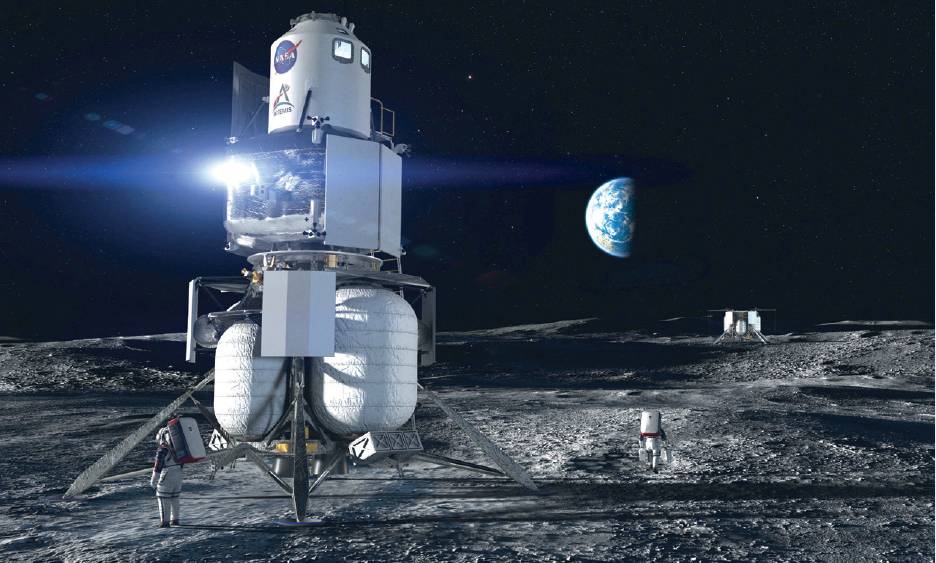
On 30 April Blue Origin’s National Team, which includes Lockheed Martin, Northrop Grumman and Draper, was awarded $579m to develop an integrated human landing system as part of NASA’s Artemis programme to return humans to the Moon. SpaceX and Dynetics were also awarded contracts to develop their landing system concepts. Blue Origin.

The author Pat Norris is an experienced engineer and writer, having published numerous times (including in this magazine) yet wears his technical knowledge lightly. Writing in a clear and jargon-free style, he modestly makes only the most fleeting of footnotes to his work at TRW (the book is, after all, not an autobiography). But these brief notes remind the reader that this is one of the few books written by one with first-hand experience.

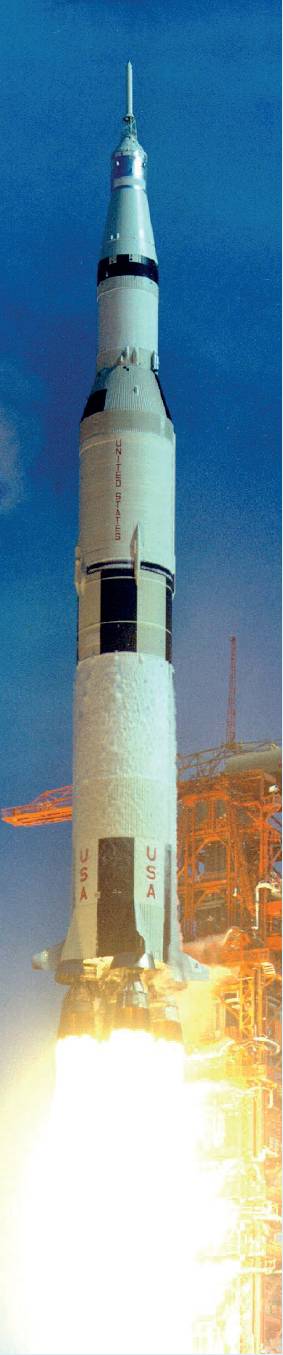
The lift-off of Apollo 15 atop its Saturn V launcher on 26 July 1971. NASA.The book opens with a more fundamental question than its title, exploring the political and technical reasons why the US went to the Moon in the first place. An overview of the Saturn V launcher follows. Rocketdyne’s development of its gigantic first stage engine – the F-1 – was fraught with combustion instabilities and self-destructing test engines, with the author introducing topics like oxidiser injection and combustion chamber stability to the layman succinctly and clearly. The instabilities weren’t merely tested experimentally but later induced deliberately; the chamber pressure was already a staggering 80atm, yet was tripled during bomb detonations to ensure that the F-1 was sufficiently trustworthy for human spaceflight.

The second stage was a bigger challenge. It had to be startable in vacuo, where conventional lubricants simply evaporate. Innovative manufacturing techniques were developed to not only build the S-II stage, but to keep its mass down, due to the increasingly heavy spacecraft atop the third stage, which came ready-designed from the Saturn 1B. The description of the spacecraft modules (command, service, lunar) is interwoven into a description of the Apollo 11 mission.

The author is open about the material he omits, such as the Gemini programme and the unmanned lunar probes. The material isn’t purely technical and the author gives a brief description of NASA’s management approach. There’s little description of management tools and processes here, being more a historical account of the techniques used (fast, but high-risk, testing of complete launchers) noting – correctly, it may be argued – that today’s NASA is far more risk-averse and cost-conscious but achieves less. The usual spaceflight superstars are mentioned (George Mueller, Sam Phillips, Jim Webb). Unfortunately, the rest of the Apollo missions – 12-17 – are squashed into a mere seven pages. The legacy of Apollo follows, described not just scientifically and managerially but also socially and politically.

A chapter about the Soviet moonshot follows, describing how it failed. Here, Norris is able give a detailed retrospective of the USSR space hardware, which would have been unavailable to the 1960s’ authors. The failure wasn’t simply down to technical inferiority; the USSR had not one but three Moon projects in parallel (robotic sample return, manned lunar flyby and manned landing), all competing for the same scarce budgets and skills. Sergei Korolev may be the most famous but the often overlooked Valentin Glushko and Vasili Mishin are also described in more detail than other authors would.

As a historical account, the book is uneven at best but it truly excels in providing an overview of present-day space programmes and their future prospects. The latter half of the book moves beyond the Cold War to the present and near future and explains why no-one has flown to the Moon since 1972. There are substantial chapters on the work of SpaceX and Blue Origin, describing how missions are becoming less governmental and more corporate. There is a sense of a baton being passed from one generation to the next. The F-1’s empirically-designed injector plate, which fed the engine with 3t of kerosene and LOX every second, is pictured alongside not Wernher von Braun, but Jeff Bezos of Amazon. There are two photos of the USSR-era R-7 derived launcher, one carrying aloft Yuri Gagarin in 1961, the other the UK’s Tim Peake in 2015.

The author doesn’t confine himself to the traditional Russian-American space powers, with China’s Moon programme deservedly receiving a chapter of its own. Russia is lumped in with ‘the rest’ in the final chapter (along with Europe, Japan, Canada, India). This, however, is less a reflection of the author’s opinions and more of national priority, as these countries have concentrated on unmanned Earth orbital and interplanetary missions.

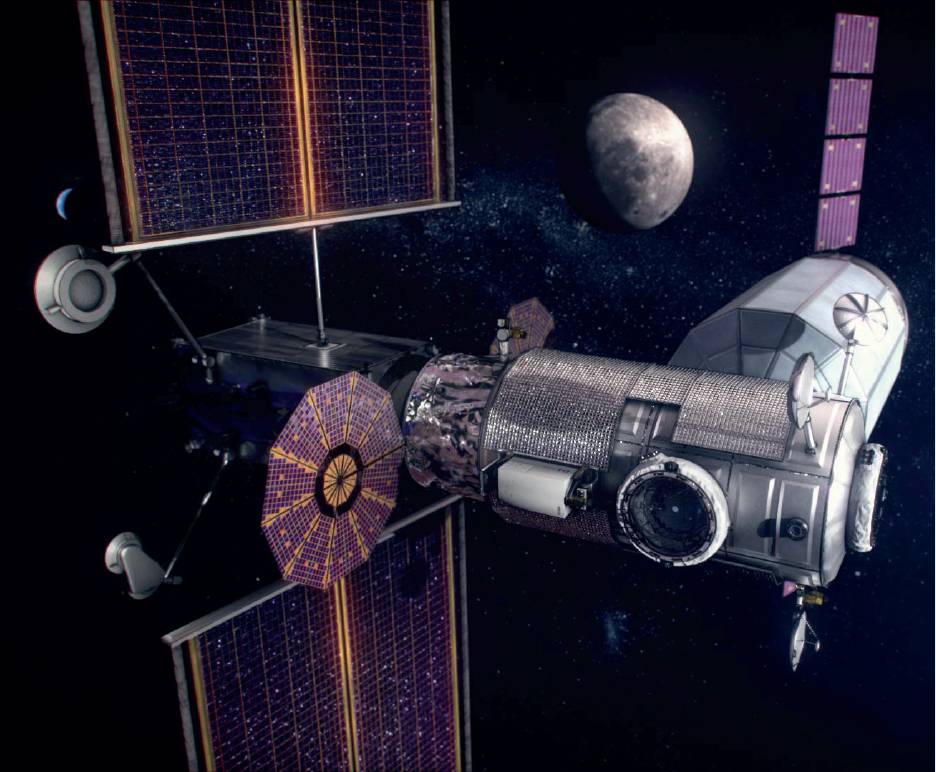
The NASA-led Lunar Gateway is a planned space station in lunar orbit intended to serve as a communication hub, science laboratory, short-term habitation module and holding area for rovers and other robots. It is expected to play a major role in NASA’s Artemis programme after 2024. NASA.

The book could have benefitted from more rigorous editing (there’s no need to point out the definition of the ton seven times, and the author appears to have confused Apollo 9’s Rusty Schweickart with Apollo 13’s Jack Swigert) and the author’s conversational style – and his fondness for exclamation marks – may irritate some readers. The Apollo 11 landing was doubtless a triumph but the author’s praise of the USA borders on hysteria, which may bring his objectivity into question.

Overall, Norris presents a well-argued and readable answer to the titular question, accessible to both technical specialists and enthusiasts alike, which this reviewer will not spoil by revealing. He concludes that somebody may well be on the Moon, perhaps funded by a private company rather than a national government, and much sooner than his readers may expect. The true test of Norris’ analysis will be time itself.

Andy Sinharay
MEng ACGI MRAeS

FOUNDATIONS OF AIRLINE FINANCE

Methodology and Practice – Third edition

By B Vasigh and Z C Rowe

Routledge, 2 Park Square, Milton Park, Abingdon OX14 4RN, UK. 2019. xxxv; 642pp. £47.99. [20% discount available to RAeS members via www.crcpress.com using AKQ07 promotion code]. ISBN 978-1-138-36781-4.

Financial management is key to the successful operation of any business and airlines are no exception. This book provides the basis for understanding economic concepts and applying them to make sound financial decisions in the airline industry.

Part 1 examines the key aspects of finance and, as such, creates a foundation from which the book develops. Although it is more finance than airline-oriented in this Part, it still introduces some airline-specific aspects. Part 2 is an exhaustive examination of financial statements and accounting practices, and a number of key financial metrics are introduced that are necessary for any airline professional to understand.

Financial management is key to the successful operation of any business, and airlines are no exception

The last two Parts are more airline-oriented dealing with numerous practical applications. Given the capital-intensive nature of aircraft acquisition, the chapters examining capital expenditures are especially useful. Not to be overlooked is the chapter dealing with operating costs and in particular fuel hedging given the recent volatility in the price of aviation fuel. This is complemented by chapters on aircraft leasing and revenue management which are vital components of successful financial management.

The third edition provides up-to-date information regarding this dynamic industry. This is complemented by numerous global case studies that are relevant, although they are dominated by US examples.

This book provides a comprehensive overview of the financial aspects of airline operations and management. It is of utility to both managers wishing to learn about the unique aspects of airlines and to aviation students wishing to become knowledgeable about financial management.

Frances Kremarik
Lecturer in Air Transport University of Westminster