Blueprint
Blueprint
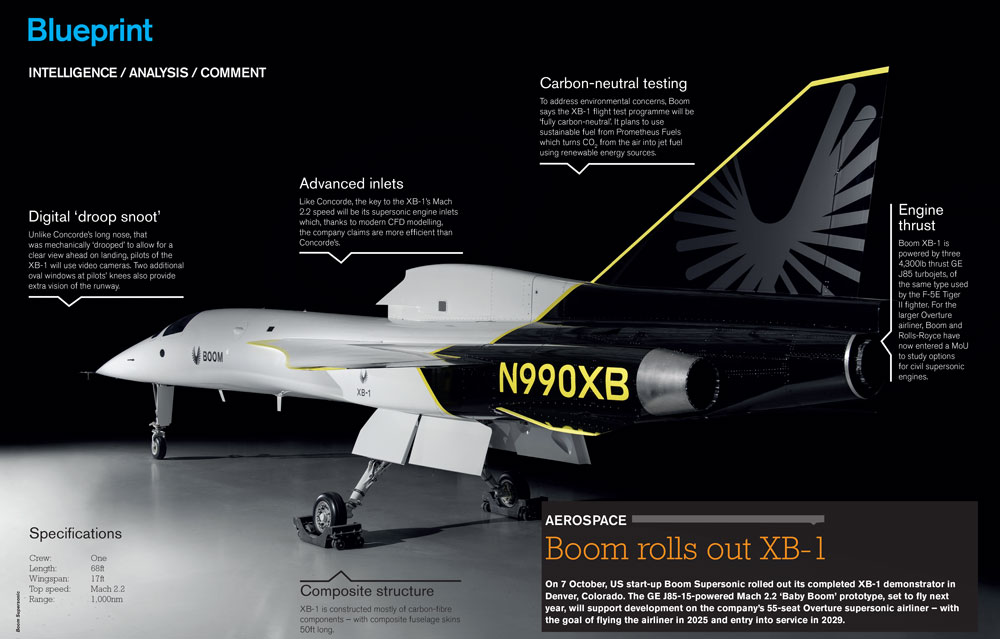
On 7 October, US start-up Boom Supersonic rolled out its completed XB-1 demonstrator in Denver, Colorado. The GE J85-15-powered Mach 2.2 ‘Baby Boom’ prototype, set to fly next year, will support development on the company’s 55-seat Overture supersonic airliner – with the goal of flying the airliner in 2025 and entry into service in 2029.
Digital ‘droop snoot’
Unlike Concorde’s long nose, that was mechanically ‘drooped’ to allow for a clear view ahead on landing, pilots of the XB-1 will use video cameras. Two additional oval windows at pilots’ knees also provide extra vision of the runway.
Specifications
Crew: One
Length: 68ft
Wingspan: 17ft
Top speed: Mach 2.2
Range: 1,000nm
Advanced inlets
Like Concorde, the key to the XB-1’s Mach 2.2 speed will be its supersonic engine inlets which, thanks to modern CFD modelling, the company claims are more efficient than Concorde’s.
Composite structure
XB-1 is constructed mostly of carbon-fibre components – with composite fuselage skins 50ft long.